Spinning Headscissors


A tijeras variation, and common lucha libre move. The attackers hooks the opponents around the head with a his legs, spins around with his upper body, and throws the victim a long distance.
All Spinning Headscissors tend to require the attacker be facing the opponent for most of the motion. As with non-spinning headscissors takedowns though, they can largely be categorized into two groups - those that grip with the bulk of the leg, and those that grip with the ankles. Unlike the more basic forms however, require explicit bracing & co-operation from the opponent (the "base") to perform. And both spend
- (1) The former, also known as the Tilt-a-whirl headscissors, is ubiquitous in lucha libre and has become commonplace in wrestling worldwide as a result. Like a basic headscissors, it is most frequently set up by running at an opponent from their side. The opponent will then be overcome with a sudden urge to perform a Sidewalk Slam, bending over slightly to pick up the oncoming attacker, chest-to-chest, face-to-crotch. Only for the attacker to continue their momentum before a firm grip can be secured, clutch their legs around the opponent's head, over-rotate across the opponent's torso and sit up under their far arm. Thus throwing the opponent forward off their feet.
- (1b) The attacker can also delay the final step and use their momentum to keep swinging the base around in circles for multiple rotations.
- (2) The leverage to sit up & match the opponent's orientation is achieved by the specifics of the leg clutch; they typically form a triangle during the move, with one straight leg pressed shin-first against the neck and one bent leg nestling their head inside the back of the knee. However, it can also be executed by keeping both legs straight and simply gripping very hard with the knees.
- (3) The tilt-a-whirl can also be initiated from a run-up across the opponent's back side rather than their front. With the attacker bracing off of the opponent's near-shoulder and seemingly going for a flying crucifix pin, only to stretch their legs past their far arm, around to the front, and onto their neck. The sequence otherwise continues as normal. More complex, but also less obvious in the target's assistance.
- (4) By the same token, a regular tilt-a-whirl can continue on around to an opponent's rear and seamlessly transition into moves like schoolboy pins or suplexes. Alternatively, they can just continue for more rotations as satellite headscissors.
- (5) There are also alternate ways for the base to lift the attacker. For example; sweeping "under" their body instead of reaching over it, by supporting their buttocks with the near arm, cradling the rest of their oncoming weight with the far arm, and bracing them once they're upside down with a grip behind their thighs ala a tombstone. By which point, the attacker's momentum is already too far-gone to stop.
-
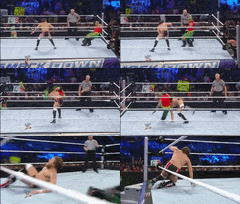 (1) Rey Mysterio on Daniel Bryan
-
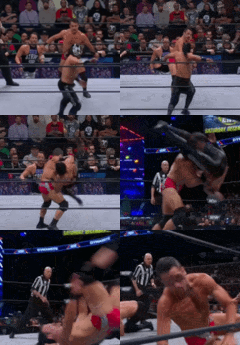 (2) Bandido on Roderick Strong
-
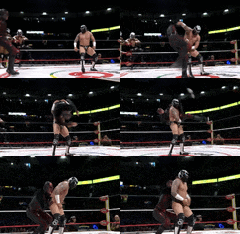 (4) Pantera Jr. on Cerebro Negro Jr.
-
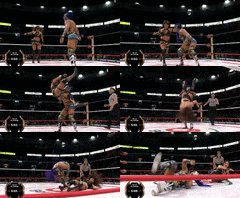 (5) Reyna Isis on Olympia


The other type, as with non-spinning headscissors, entails gripping the opponent's head with the ankles rather than the bulk of the legs. However, this method is relatively unique in that there is no one simple default set-up. Likely due to the difficulty in gaining the necessary momentum for the "spin". Thus (to conject) encouraging improvisation those ambitious enough to attempt it. This ironically puts it at direct odds with its spinless counterpart & its lack of variants.
- (5) Perhaps the technique most representative of the name "Spinning Headscissors" is when an attacker applies the grip from any number of stationary positions (a backflip, a handstand, even as a counter whilst laying on the ground), places both hands on the mat, and then skitter to the side with them whilst maintaining the hold. Thus building up enough lateral speed to force the opponent to spin until their neck is released.
- (6) this is also the tijeras variant most associated with "slingshots", as an attacker who applies the hold whilst gripping the top rope can then push themselves off of it & to the side to provide the swing.
- (7) The sweeping-lift version of the tilt-a-whirl headscissors - listed above as (4) - can also end with an inward-facing ankle-hooking tijeras instead. It's an easy enough change, as the attacker need simply grip the opponent's head with the lower regions of their legs once they enough height.
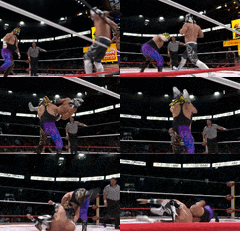
- (7b) The attacker can also use the opportunity to vault themselves upward by bracing against the recipient's outstretched arm & shoulder, thus putting distance between their two bodies during their spin upside-down for a more spectacular visual effect. This version is most reminiscent of the basic tilt-a-whirl headscissors.
- (8) The behind-the-back method is trickier to change, and essentially requires the opponent make what looks to be a split-second Beach Break attempt.
- (9) in a tag match setting, the momentum can be supplied by a second opponent besides the target. Whether it be by something as simple as vaulting off of their body first, or by using an attempted flapjack to one's advantage. Neon in particular likes the latter.
-
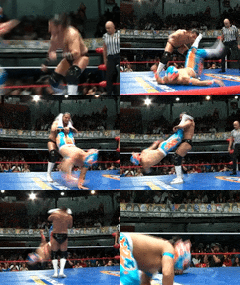 (5) Neon on Angel de Oro
-
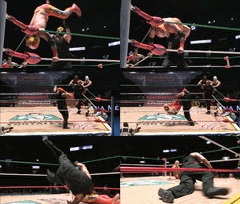 (6) Fuego
-
-
 (7b) Arkalis on a Calavera
-
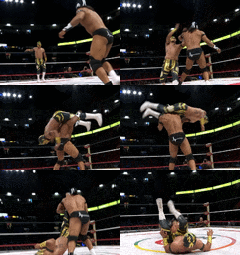 (8) Infinito on Cerebro Negro Jr.


It can be used to set up other moves, if the opponent is held onto rather than released & thrown. Most famously, the behind-the-back tilt-a-whirl precedes Mistico's iconic finish, La Mistica. Masato Yoshino also also made a habit of the practice, with variants including Speed Star (crucifix), Torbellino (facebuster), Ude Yoshino (Cross Armbreaker), and From Jungle (Octopus Hold).
